.png)
Trialling wetland plants to keep trough water clean
By Ruth Mollison
Nan Bray runs a sheep farm in the Southern Midlands, producing White Gum Wool - much loved by knitters. Nan is not afraid of trying different solutions to problems in sheep farming.
One of the problems is keeping the water troughs clean of algae and silt in the grazing paddocks.
With the help of Antje Werner, a PhD student, Nan devised a plan to place small floating wetlands in each trough as a natural cleansing device. Read the fullstory of the floating wetland idea here.
I have been interested in wetlands forever and decided to join in the project for a day, contributing some wetland plants from the Understorey Network nursery for the floating structures.
The structures were made using left over polypipe and bird netting from the farm shed. We glued corners onto polypipe sections to make large rectangles (for dams) or small squares (for sheep troughs). Then the bird netting was lashed onto each structure with zip ties. This made a netting 'sandwich' to nestle the plants into, and to float freely on the water surface. Once the technique was worked out it didn't take long to make half a dozen floating wetlands.
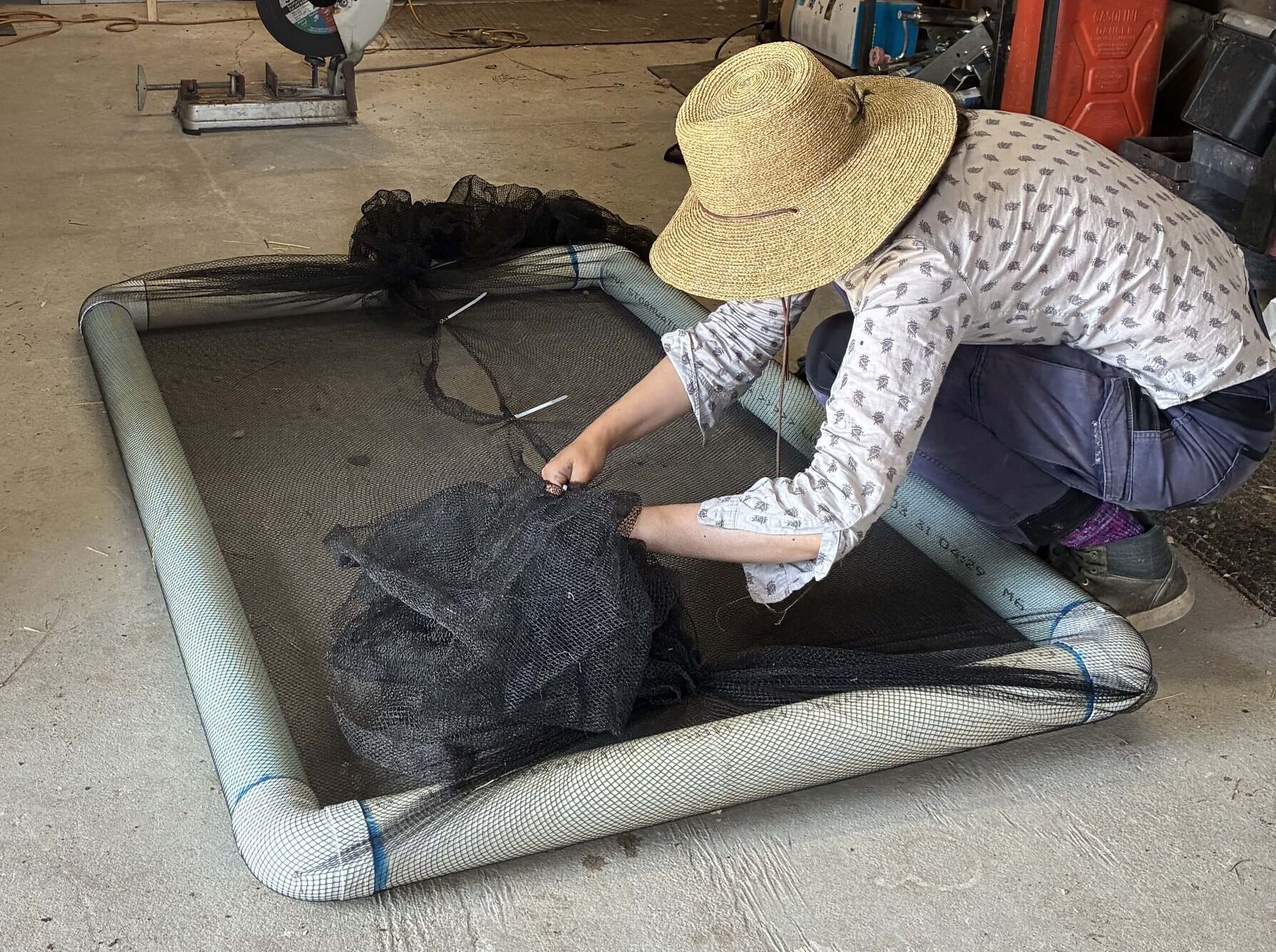

We chose a range of wetland plants to trial, keeping in mind that the plants were suspended above the bottom substrate and had to absorb nutrients from the water.
The most obvious candidates are the free floating water plants Azolla filiculoides (azolla) and Lemna spp. (duckweed). They are tiny plants that rapidly expand in number in high nutrient water, taking up the nutrients through their roots. They also disappear rapidly if conditions aren't right. In a contained water body they can be harvested and fed to stock or used as a garden fertiliser.
The next best candidates are the submerged species. The species we used are Triglochin procerum (water ribbons), Myriophyllum spp. (watermilfoil) and Potamogeton spp.(pondweed). All these species are happy to grow below the water surface, with leaves lying flat on the surface. This minimises damage from the wind, and these species are also good at taking up excess nutrients from the water column. After that we have trialled some emergent species - Bolboschoenus caldwellii (marsh club-rush), Gunnera cordifolia (Tasmanian mudleaf) and Ornduffia reniformis (running marsh flower)- that usually grow on the muddy edge of waterways to see how they go.
Hopefully the plants will settle into their new abode beforewinter, and then flourish in spring. As they grow they will absorb excess nutrients and shade the water, thereby reducing algae growth and improving the water quality for the sheep. The birds and frogs will be happy with their new habitat niche, a bonus in the dry paddocks.
The most successful species in this design can then be propagated and more floating wetlands built. Watch this space for the results!
If you want to learn more about USN or how you can get involved, we invite you to contact us via our contact information, email or social media.
Contact Us